 By admin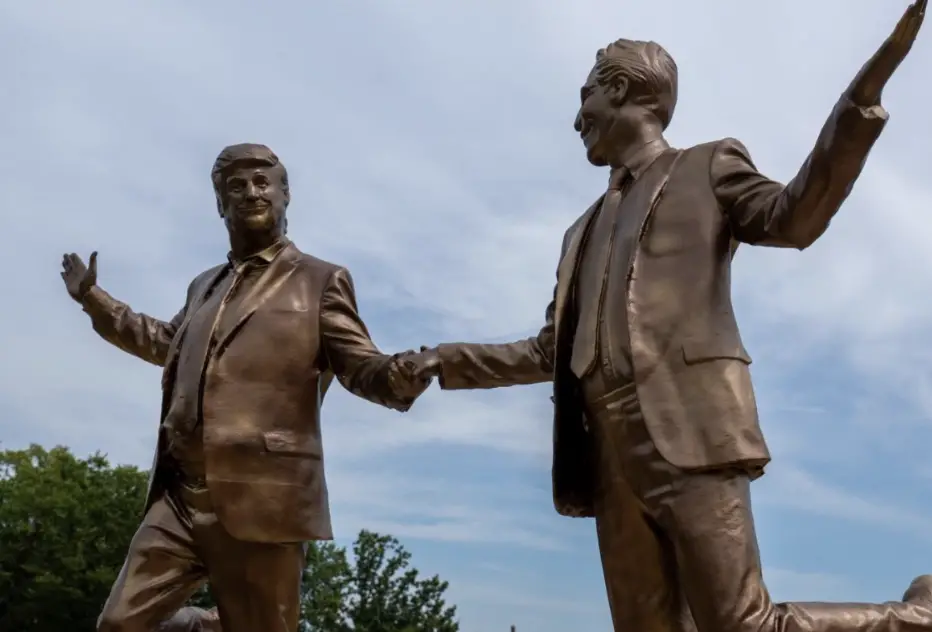
Donald Trump has condemned a new statue on the National Mall that depicts him holding hands with Jeffrey Epstein, dismissing the installation as a partisan stunt while reiterating his claim that he banished the financier from his private club years before Epstein’s 2019 arrest. “Liberals are free to waste their money however they see fit — but it’s not news that Epstein knew Donald Trump, because Donald Trump kicked Epstein out of his club for being a creep,” White House spokeswoman Abigail Jackson said in a statement in response to the artwork’s appearance in Washington, where it drew crowds and swift national attention.
The statement added: “Democrats, the media, and the organization that’s wasting their money on this statue knew about Epstein and his victims for years and did nothing to help them while President Trump was calling for transparency, and is now delivering on it with thousands of pages of documents.”
The spray-painted bronze statue, titled “Best Friends Forever,” was placed early Tuesday on the east end of the Mall near the U.S. Capitol. It shows the former president and the late financier smiling and clasping hands, each with one foot kicked back as if mid-frolic.
A plaque at the base reads: “We celebrate the long-lasting bond between President Donald J. Trump and his ‘closest friend,’ Jeffrey Epstein.” The National Park Service issued a permit allowing the piece to remain on site until 8 p.m. on Sunday; the permit application described the purpose as “to demonstrate freedom of speech and artistic expression using political imagery.”
The installation is the latest in a series of unsanctioned protest artworks aimed at Trump by an anonymous collective that has previously placed pieces on the Mall, including one labeled “Dictator Approved” that appropriated laudatory lines about Trump from authoritarian leaders.
The authorship of the new statue has not been officially confirmed by authorities, but outlets that were tipped off to its placement reported receiving messages from a person claiming to be part of the group. The materials used in the 12-foot piece include wood, foam and resin beneath a metallic finish, according to reports that cited the group’s description of its fabrication.
Two additional plaques installed with the statue reference an alleged birthday greeting to Epstein that House Democrats made public this month, and which was first described in a Wall Street Journal article now at the center of Trump’s defamation lawsuit against the newspaper.
The Journal reported that the greeting included a crude drawing and lines of invented dialogue suggesting affinities between the two men; Trump has denied authoring any such note and is seeking damages. The paper asked a federal judge this week to dismiss the suit, calling it a threat to press freedom; the filing argued the greeting posted by Congress was “identical” to the letter the Journal reported on in July.
Trump’s response to the statue reprises themes the White House and his allies have emphasized since renewed scrutiny of Epstein’s associations erupted this summer: that Trump distanced himself from Epstein long before the financier’s sex-trafficking case, that he barred Epstein from Mar-a-Lago, and that there is no public evidence linking Trump to criminal conduct involving Epstein.
The Washington Post noted that when Epstein was arrested in 2019, Trump said, “I had a falling-out with him a long time ago. I don’t think I’ve spoken to him for 15 years. I wasn’t a fan.” The Post also reported that “there is no public evidence of inappropriate behavior by Trump” related to Epstein.
The statue’s text and timing are calibrated to evoke that history. One plaque quotes the line, “We celebrate the long-lasting bond,” while another reproduces excerpts of the purported 2003 “birthday book” entry ascribed by the Journal to Trump and now contested in court.
News outlets that spoke with a representative of the artist collective reported the group chose September because it is colloquially dubbed “Friendship Month,” and said the piece was meant to visualize “what that friendship might feel like.” The National Park Service permit, cited by local and national outlets, confirms the display window and the stated intention to make a political statement on public ground.
Trump’s social ties to Epstein date to the late 1980s and early 2000s, when they lived and entertained in the same Palm Beach and New York circles. In 2002, Trump told New York magazine: “I’ve known Jeff for 15 years. Terrific guy. He’s a lot of fun to be with. It is even said that he likes beautiful women as much as I do, and many of them are on the younger side.”
As president in 2019, after Epstein’s arrest, Trump publicly reversed the tone, saying he had not spoken to Epstein in roughly 15 years and “wasn’t a fan,” and more recently has said he ejected Epstein from Mar-a-Lago over conduct involving club staff. The Independent, which reported on the statue’s appearance, highlighted the 2002 remark, while the Post recorded the later repudiation.
The White House statement on Tuesday sought to fold the Mall installation into a broader defense of the administration’s posture on records tied to Epstein, asserting Trump has “called for transparency” and has overseen the release of “thousands of pages of documents.”
The claims have not quelled calls from critics and some supporters for additional disclosures, but they underscore the political backdrop against which the statue appeared. In recent days, the House released material it said came from Epstein’s estate, and the Justice Department has described its document releases as consistent with legal obligations while rejecting conspiracy claims about a secret “client list.”
The artists behind “Best Friends Forever” have avoided personal attribution, telling reporters they preferred that the work “speak for itself.” In interviews reported by national outlets, the collective linked the statue to a series of satirical pieces lampooning Trump or his supporters, including an installation last year that spoofed a January 6 tableau and a summer piece that riffed on foreign strongmen’s praise for Trump. Reporters said the individual claiming authorship provided details about the placement and construction that were consistent with past appearances, though his identity was not independently verified.
Reaction on the Mall ranged from curiosity to anger, with onlookers photographing the piece and reading the plaques as park rangers monitored the area. The Park Service permit allows expressive installations that do not damage grounds or obstruct traffic, and in this case specifies a removal time on Sunday evening.
Similar pop-up artworks have been allowed in recent months, including an unrelated tribute that placed a gold-toned Trump figure with a Bitcoin motif on the grounds. The agency did not immediately respond to questions about security or whether additional applications had been filed for related displays.
The figure of Epstein—who died by suicide in federal custody in 2019 while awaiting trial—has remained a volatile presence in U.S. political culture, and the Mall installation ensured his name and image would again be pressed into a contest over Trump’s record and associations.
The White House’s phrasing on Tuesday framed the artwork as a partisan provocation and pointed to the claim that Trump expelled Epstein from Mar-a-Lago, a detail included in the administration’s messaging for months. Trump’s lawsuit over the Journal’s reporting, now facing a dismissal motion, keeps the alleged birthday note—and by extension, the question of how Trump’s relationship with Epstein is memorialized—before a federal judge.
The statue’s emergence also coincides with congressional skirmishing over what more, if anything, should be disclosed from government files connected to Epstein and his longtime associate Ghislaine Maxwell, now serving a 20-year sentence.
While Trump and some allies have at times pledged broad transparency, official releases have been piecemeal and heavily caveated, and the Justice Department has stated that additional disclosures could compromise privacy or investigative equities. The White House on Tuesday leaned into the claim that the administration has “delivered” records; opponents dispute both the volume and substance of what has been made public to date.
What the Mall piece achieves, at least temporarily, is to fuse a running political argument with a public, physical object that places Trump and Epstein side by side within sight of the Capitol dome.
Its plaques quote and paraphrase language that has surfaced in litigation and congressional publications; its posture mirrors archival images of the two men smiling in the same social orbit two decades ago; and its presence on federal land invokes First Amendment protections that allow critical art to be staged in the nation’s front yard.
For Trump, the official reply was to dismiss the creators’ motives and to emphasize his claim of having severed ties with Epstein years ago. For passersby on Tuesday, the piece offered a provocation and a photo opportunity—one the Park Service says will end at 8 p.m. Sunday, when the statue is due to be removed.
Trump’s distancing language has remained consistent since Epstein’s 2019 arrest—“I had a falling-out with him a long time ago… I wasn’t a fan”—even as references to their past acquaintanceship circulate in court filings, congressional releases and activist art.
The White House’s line on Tuesday, delivered in the statement that framed the statue as a waste of money, folded that history into a broader rebuttal: that it is unfair to conflate knowing Epstein with participating in his crimes, and that the administration’s record on disclosures proves its commitment to transparency. The installation’s authors offered no counter-statement beyond the gleaming figures and plaques they left in place. On the Mall, art and politics were allowed to meet until the permit clock runs out.